

800
ISHA, UNSCRIPTED
Isha Patel is the black sheep of the family. She doesn’t have a “prestigious” degree or a “real” career, and her parents never fail to remind her. But that’s okay because she commiserates with her cousin, best friend, and fellow outcast, Rohan.
When Isha has a breakthrough getting her script in front of producers, it doesn’t go according to plan. Instead of letting her dreams fall through the cracks, Rohan convinces her to snag a pitch session with an Austinite high-profile celeb: the one and only Matthew McConaughey, who also happened to be her professor at the University of Texas years ago—he has to remember her, right?
Chasing Matthew McConaughey isn’t easy. Isha needs a drink or two to muster up courage, and she gets a little help from the cutest bartender she’s ever encountered. But when the search for the esteemed actor turns into a night of hijinks and unexpected—albeit fun—chaos, everything falls apart. Isha’s dreams seem farther than ever, but she soon realizes who she really needs to face and that her future may just be alright, alright, alright.
800

650
KAFKA ON THE SHORE
Kafka on the Shore is powered by two remarkable characters: a teenage boy, Kafka Tamura, who runs away from home either to escape a gruesome oedipal prophecy or to search for his long missing mother and sister; and an aging simpleton called Nakata, who never recovered from a wartime affliction and now is drawn toward Kafka for reasons that, like the most basic activities of daily life, he cannot fathom.
As their paths converge, and the reasons for that convergence become clear, Haruki Murakami enfolds readers in a world where cats talk, fish fall from the sky, and spirits slip out of their bodies to make love or commit murder. Kafka on the Shore display one of the world's great story tellers at the peak of his powers.
650

900
KILL SWITCH. DEVIL'S NIGHT 3
Sending Damon to prison was the worst thing Winter could’ve done. It didn’t matter that he did the crime or that she wished he was dead. Winter thought he’d cool off in jail and be anything but the horror he was, or that at the very least she’d have time to disappear before he got out.
But she was wrong. Three years came and went too fast, and prison only gave him time to plan. And while Winter anticipated his vengeance, she didn’t expect this. He doesn’t want to make her hurt. He wants to make everything hurt.
Damon knows he needs to get rid of Winter’s father, giving her, her sister, and her mother nowhere to run. The Ashby women are desperate for a knight in shining armor. But that’s not what’s coming.
It’s time Damon took control of his future. It’s time he showed them all that he will never stop being the nightmare they think he is.
Damon won’t have to break into her home to do it.
As the new man of the house, he has all the keys.
900

995
KISS ME, MI AMOR
Enrique Montez, smooth-talking heir to the Taco King empire, is man enough to admit that he made a critical error when he underestimated Carolina Flores. The agricultural hotshot should have been an easy conquest—who would turn down the chance to partner with California’s largest fast-food chain? But instead of signing her name on the dotted line, Carolina has Enrique eating out of the palm of her hand, and when fate steps in with an unexpected opportunity, Enrique is willing to do whatever it takes to capture her heart.
Growing up as the daughter of farmworkers, Carolina spent her youth picking strawberries in the fields of Santa Maria and vowing to improve the lives of people like her parents. Now, as one of only a few Latina farm owners, she has no time for romance and she’s certainly not about to let the notorious Montez brother anywhere near her business—even if just being near Enrique makes her skin tingle.
But she is willing to let him help get her overinvolved family off her back. When Carolina’s father and her lovelorn sisters mistake Enrique for her (nonexistent) boyfriend, she reluctantly agrees to a series of pretend dates to their town’s traditional Mexican-American holiday celebrations. Soon the fake feelings turn real and both Carolina and Enrique must convince each other to take a chance on love before their vacation romance is over.
995

2,500
LE GUIN: FIVE NOVELS (LOA #379)
This 7th volume in the definitive Library of America edition of Ursula K. Le Guin’s works presents 5 remarkable standalone novels that showcase her boundless creativity and literary range.
In the Locus Award–winning The Lathe of Heaven (1971), one of Le Guin’s most admired works of science fiction, George Orr begins have effective dreams: dreams that change reality itself. But when he turns to the sleep researcher William Haber for help, the doctor sees an opportunity to use Orr’s strange gift for his own ends.
A former Terran prison colony on the planet Victoria seems destined for revolution in The Eye of the Heron (1978), when the authoritarian leaders in the City try to assert control over the peaceful farmers who have been sent to live around them.
The Beginning Place (1980) is a parable-like story in which Hugh and Irena have both found their way to the Beginning Place, a gateway to another world. The two initially become enemies, but must learn to work together when the utopia they’ve found turns out to have a shadow.
The long out-of-print Searoad: Chronicles of Klatsand (1991) is a Winesburg, Ohio-like series of linked stories set in a small vacation town on the Oregon coast, where some of the characters have come for a weekend and some for longer, but all are pilgrims in the grip of inexpressible longings.
2,500
1,100
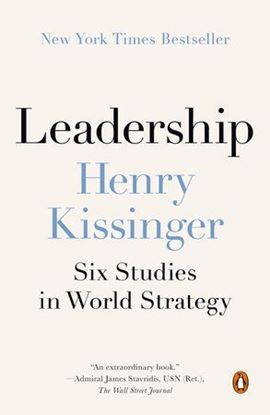
LEADERSHIP
“Leaders,” writes Henry Kissinger in this compelling book, “think and act at the intersection of two axes: the first, between the past and the future; the second, between the abiding values and aspirations of those they lead. They must balance what they know, which is necessarily drawn from the past, with what they intuit about the future, which is inherently conjectural and uncertain. It is this intuitive grasp of direction that enables leaders to set objectives and lay down a strategy.”
1,100