
2,995
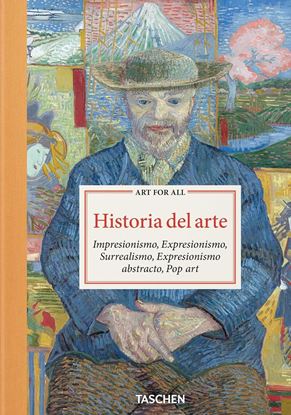
ART FOR ALL. HISTORIA DEL ARTE
A comprehensive volume covering five seminal genres that shaped art, from the late 19th century and well into the 20th: Impressionism, Expressionism, Surrealism, Abstract Expressionism and Pop Art. Each approach was distinct in aesthetic and philosophy, but all had immediate impact and enduring influence. Many great names were indelibly associated with one, some explored several during their careers.
Impressionism, led by Monet and Renoir, focused on light and color, capturing fleeting moments and challenging academic art's rigidity. Expressionism was driven by artists like Edvard Munch and Wassily Kandinsky to convey raw emotion, distorting reality to reflect the angst of human experience. Surrealists, like Salvador Dalí and René Magritte, explored the subconscious, dreams, and the irrational, blending reality with fantasy across art, literature, and film. With Jackson Pollock and Mark Rothko leading the charge, Abstract Expressionism emphasized spontaneity and emotion through bold, gestural brushstrokes, and established New York as the post-war art world’s new Mecca.
2,995
6,500
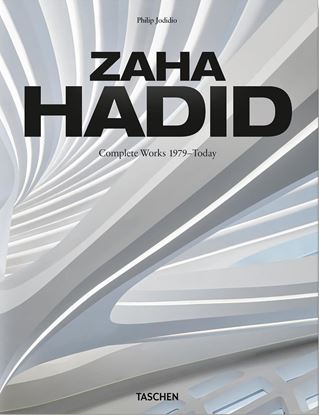
ZAHA HADID. COMPLETE WORKS 1979-TODAY 20
Zaha Hadid (1950 - 2016) was a revolutionary architect. For years, she was widely acclaimed and won numerous prizes despite building practically nothing. Some even said her work was simply impossible to build. Yet, during the latter years of her life, Hadid’s daring visions became a reality, bringing a new and unique architectural language to cities and structures such as the Port House in Antwerp, the Al Janoub Stadium near Doha, Qatar, and the spectacular new airport terminal in Beijing.
By her untimely death in 2016, Hadid was firmly established among architecture’s finest elite, working on projects in Europe, China, the Middle East, and the United States. She was the first female architect to win both the Pritzker Prize for architecture and the prestigious RIBA Royal Gold Medal, with her long-time Partner Patrik Schumacher now the leader of Zaha Hadid Architects and in charge of many new projects.
6,500
2,995
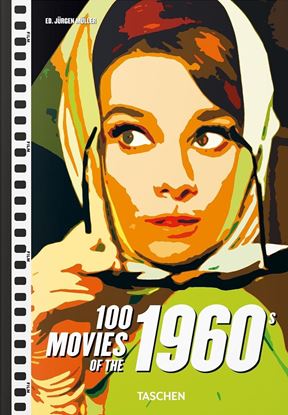
100 MOVIES OF THE 1960S
Positioned precariously between the uptight ’50s and the freewheeling ’70s, the 1960s marked a transitional decade in the film industry. As art, mass market, and pop culture merged and collided in true pop art style, cinema swirled with psychedelic energy. This handbook gathers the best films of the era, exploring the making and the mastery of such cinematic star turns as The Leopard, The Birds, Belle de Jour, A Fistful of Dollars, and Doctor Zhivago.
With audiences ever more glued to their TV sets and the loosened rules about what was “permissible” in cinema with the abolition of the Production Code, filmmakers embraced the freedom to explore the possibilities of film as an art form. As was often the case, the Europeans led the way, the French with Nouvelle Vague directors like Godard and Truffaut, and the Italians with such innovative films as Fellini’s 8 1/2 and Antonioni’s Eclipse.
2,995
2,995
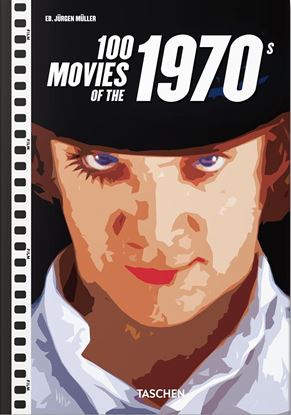
100 MOVIES OF THE 1970S
The 1970s: that magical era betwixt the swinging ’60s and the decadent ’80s, the epoch of leisure suits and Afros, the age of disco music and platform shoes. As war raged on in Vietnam and the Cold War continued to escalate, Hollywood began to heat up, recovering from its commercial crisis with box-office successes such as Star Wars, Jaws, The Exorcist, andThe Godfather. Thanks to directors like Spielberg and Lucas, American cinema gave birth to a new phenomenon: the blockbuster.
Meanwhile, across the Atlantic, while the Nouvelle Vague died out in France, its influence extended to Germany, where the New German Cinema of Fassbinder, Wenders, and Herzog had its heyday. The sexual revolution made its way to the silver screen (cautiously in the U.S., more freely in Europe) most notably in Bertolucci’s steamy, scandalous Last Tango in Paris. Amid all this came a wave of nostalgic films (The Sting, The Last Picture Show) and Vietnam pictures (Apocalypse Now, The Deer Hunter), the rise of the antihero (Robert De Niro, Al Pacino, Dustin Hoffman), and the prestigious short-lived genre, blaxploitation.
2,995

1,995
20TH CENTURY ALCOHOL & TOBACCO ADS. 40
Vices or virtues: drinking and smoking provided marketers with products to be forged into visual feasts. In this lush compendium of advertisements, we explore how depictions of these commodities spanned from the elegant to the offbeat, revealing how manufacturers prodded their customers throughout the 20th century to imbibe and inhale.Each era’s alcohol and tobacco trends are exuberantly captured page after page, with brand images woven into American popular culture so effectively that almost anyone could identify such icons as the Marlboro Man or Spuds MacKenzie, figures so familiar they could appear in ads without the product itself.
1,995
1,995
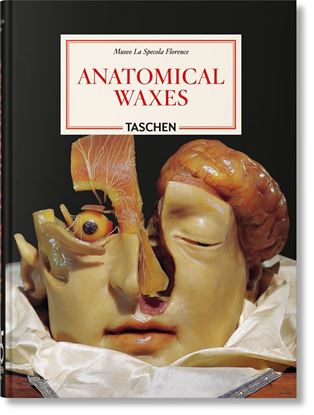
ANATOMICAL WAXES. 45TH ED.
A book that gets under the skin in every sense, containing hundreds of vivid photographs of intricate anatomical waxworks, created more than two centuries ago to astounding levels of accuracy. The models were intended to advance medical understanding at a time when scientific curiosity and intellectual fervor were sweeping Europe. Housed in Florence’s La Specola museum, which opened its doors in 1775 to visitors of all social classes―itself a visionary notion at the time―, the specimens have served as both educational tools and objects of public fascination ever since.
1,995
1,995
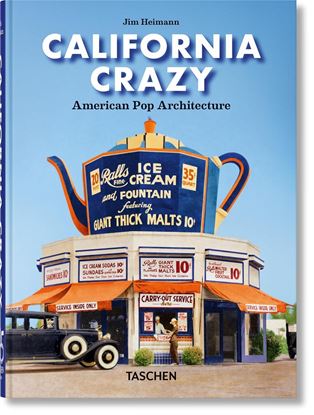
CALIFORNIA CRAZY. AMERICAN POP ARCHITEC
At the dawn of the automobile age, Americans’ predilection for wanderlust prompted a new wave of inventive entrepreneurs to cater to this new mode of transportation. Starting in the 1920s, attention-grabbing buildings began to appear that would draw in passing drivers for snacks, provisions, souvenirs, or a quick meal. The architectural establishment of the day dismissed these roadside buildings as “monstrosities”.
1,995
1,850
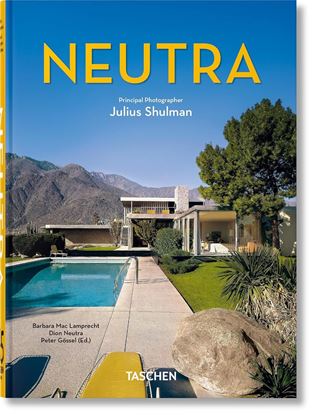
NEUTRA. 45TH ED.
Originally from Vienna, Richard Neutra came to America early in his career, settling in California. His influence on postwar architecture is undisputed, the sunny climate and rich landscape being particularly suited to his cool, sleek modern style.
Neutra had a keen appreciation for the relationship between people and nature; his trademark plate glass walls and ceilings which turn into deep overhangs have the effect of connecting the indoors with the outdoors. His ability to incorporate technology, aesthetics, science, and nature into his designs brought him to the forefront of Modernist architecture.
1,850
1,995
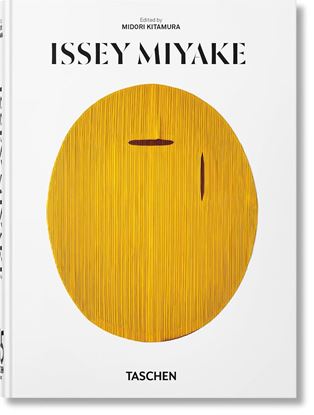
ISSEY MIYAKE. 45TH ED.
In 1983, Japanese designer Issey Miyake told The New Yorker that he aspired “to forge ahead, to break the mold.” With the boundary-defying fashion lines that followed, he not only broke molds, but recast clothing altogether. With a unique fusion of poetry and practicality, his creations blur the boundaries between tradition, modern technology, and everyday function.
This definitive history of Miyake’s clothes from 1960 to 2022 offers expert insight into the designer’s vision and daring. Initiated and conceived by Midori Kitamura, the book looks at the texture-driven originality of Miyake’s materials and techniques from the very earliest days of his career, before he had even established the Miyake Design Studio. Drawing on nearly 50 years of collaborative work with Miyake, Kitamura creates an encyclopedic reference of his material and technical innovations through the clothes based on A Piece of Cloth concept, Body Series of the 1980s, Miyake Pleats series, and such practical, everyday designs as Pleats Please pieces.
1,995
1,995
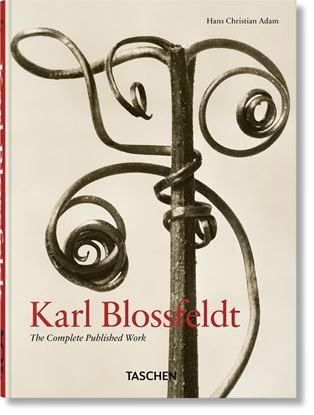
KARL BLOSSFELDT. THE COMPLETE PUBLISHED
German photography pioneer Karl Blossfeldt (1865–1932) photographed plants so beautifully, and with such originality, that his work transcends the medium itself. Over more than 30 years, he took thousands of photographs, revealing a formally rigorous talent whose precision and dedication bridge the 19th- and 20th-century worlds of image-making and bring a distinctly sculptural aspect to a firmly two-dimensional art form.
Beautifully but starkly composed against plain cardboard backgrounds, Blossfeldt’s images, relying on a northern light for their sense of volume, reveal nothing of the man but everything of themselves. They are still lifes, piercingly final statements on their subject, and have endured owing to their aesthetics and the ongoing fascination of students and photographers. Like their maker, they are quietly and lastingly effective.
1,995