


1,350
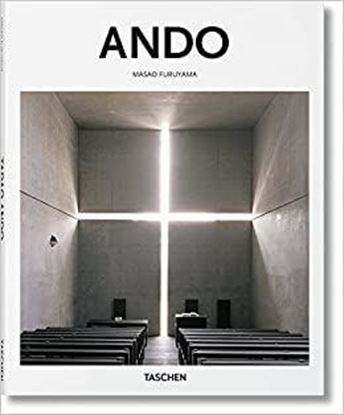
ANDO (BA-ARCH) (GB) (INT)
In this essential TASCHEN introduction to Tadao Ando we explore the hybrid of tradition, modernism, and function that allows his buildings to enchant architects, designers, fashion designers, and beyond. Through key projects including private homes, churches, museums, apartment complexes, and cultural spaces, we explore a uniquely monumental yet comforting aesthetic that draws as much on the calm restraint of Japanese tradition as the compelling modernist vocabularies of Bauhaus and Le Corbusier.
With featured projects in Japan, France, Italy, Spain, and the United States, we see not only Ando’s global reach but also his refined sensitivity for the environs: the play of light through windows, and, in particular, the interaction of buildings with water. From the mesmerizing Church of the Light in Osaka to the luminous Punta della Dogana Contemporary Art Center in Venice, this is a radiant tour through a distinctly contemporary form as much as a timeless appeal of light, elements, and equilibrium.
1,350
1,350
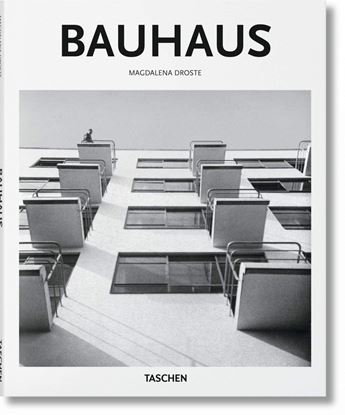
BAUHAUS (BA-ARCH) (GB)
In a fleeting fourteen year period, sandwiched between two world wars, Germany’s Bauhaus school of art and design changed the face of modernity. With utopian ideals for the future, the school developed a pioneering fusion of fine art, craftsmanship, and technology to be applied across painting, sculpture, design, architecture, film, photography, textiles, ceramics, theatre, and installation.
As much an intense personal community as a publicly minded collective, the Bauhaus was first founded by Walter Gropius (1883–1969), and counted Josef and Anni Albers, Wassily Kandinsky, Paul Klee, Oskar Schlemmer, Gunta Stölzl, Marianne Brandt and Ludwig Mies van der Rohe among its members. Between its three successive locations in Weimar, Dessau and Berlin, the school fostered charismatic and creative exchange between teachers and students, all varied in their artistic styles and preferences, but united in their idealism and their interest in a “total” work of art across different practices and media.
1,350
1,350
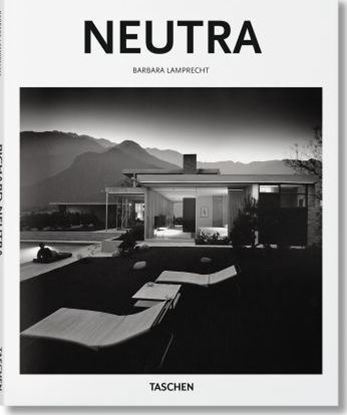
NEUTRA (BA-ARCH) (GB)
In the architecture of Richard Neutra (1892–1970), inside and outside find their perfect modernist harmony. As the Californian sun glints off sleek building surfaces, vast glass panel walls allow panoramic views over mountains, gardens, palm trees, and pools.
Neutra moved to the United States from his native Vienna in 1923 and settled in Los Angeles. He displayed his affinity with architectural settings early on with the Lovell House, set on a landscaped hill with views of the Pacific Ocean and Santa Monica Mountains. Later projects such as the Kaufmann House and Nesbitt House would continue this blend of art, landscape, and living comfort, with Neutra’s clients often receiving detailed questionnaires to define their precise needs.
This richly illustrated architect introduction presents the defining projects of Neutra’s career. As crisp structures nestle amid natural wonders, we celebrate a particularly holistic brand of modernism which incorporated the ragged lines and changing colors of nature as much as the pared down geometries of the International Style.
1,350
1,350
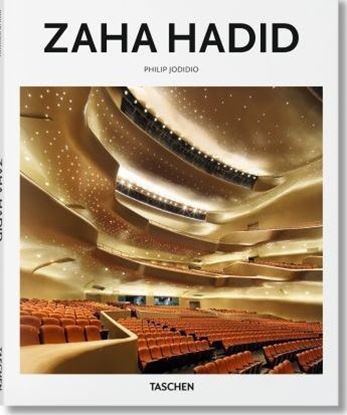
HADID (BA-ARCH) (GB)
Zaha Hadid was a revolutionary architect, who for many years built almost nothing, despite winning critical acclaim. Some even said her audacious, futuristic designs were unbuildable.
During the latter years of her life, Hadid’s daring visions became a reality, bringing a unique new architectural language to cities and structures as varied as the Rosenthal Center for Contemporary Art in Cincinnati, hailed by The New York Times as “the most important new building in America since the Cold War”; the MAXXI Museum in Rome; the Guangzhou Opera House in China; and the London 2012 Olympics Aquatics Centre.
At the time of her unexpected death in 2016, Hadid was firmly established among the elite of world architecture, recognized as the first woman to win both the Pritzker Prize for architecture and the RIBA Royal Gold Medal, but above all as a giver of new forms, the first great architect of the noughties.
From her early sharply angled buildings to later more fluid architecture that made floors, ceilings, walls, and furniture part of an overall design, this essential introduction presents key examples of Hadid’s pioneering practice. She was an artist, as much as an architect, who fought to break the old rules and crafted her own 21st-century universe.
1,350
1,350
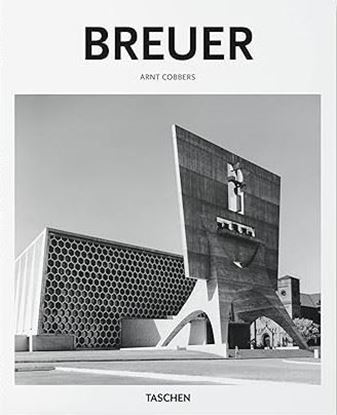
BREUER. ARNT COBBERS (BA-ART) (GB)
In 1956, TIME magazine called him one of the defining “form-givers of the 20th century.” Today, Marcel Breuer (1902–1981) remains a locus classicus of modernism for architects and designers alike. As a Bauhaus pioneer, even his earliest work was marked by a material restraint; the balance of texture, color, and shape; and a symbiosis of local and global, big and small, rough and smooth.In this essential introductory monograph, we survey Breuer’s complete career through some of his most influential projects and ideas, from his landmark tubular furniture to the MoMA Research House to his innovation of “binuclear” housing, splitting living and sleeping areas into separate wings. Along the way, we follow Hungarian-born Breuer’s journey to international acclaim, with featured projects from Germany, France, England, Switzerland, and across the United States contributing to his global status as a modernist maestro.
1,350
1,350
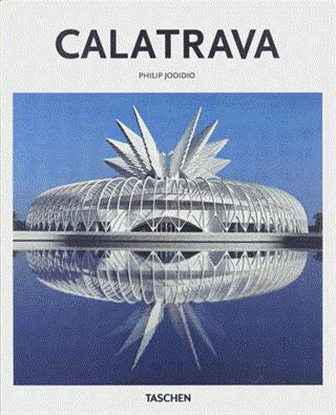
CALATRAVA (BA-ARCH)
Con su trabajo visionario, el valenciano Santiago Calatrava (Benimámet, 1951) ha conseguido el reconocimiento internacional como arquitecto, ingeniero estructural, escultor y artista. Famoso tanto por sus puentes como por sus edificios, en su obra destacan las estructuras de aires neofuturistas, que combinan hábiles soluciones de ingeniería con un impacto visual asombroso. Desde el Complejo Deportivo Olímpico de Atenas 2004 y el reciente Museo del Mañana de Río de Janeiro hasta los puentes de la Paz, en Calgary; del Alamillo, en Sevilla, y de la Mujer, en Buenos Aires, los proyectos de Calatrava inciden especialmente en la relación entre el movimiento y el equilibrio. Con fuentes de inspiración tan diferentes como los diseños espaciales de la NASA o los estudios de anatomía de Leonardo Da Vinci, las obras del arquitecto español fascinan por la sensación de ligereza, agilidad y aerodinamismo que transmiten mientras mantienen una elegante relación con su entorno. Esta monografía concisa explora la singular estética de Calatrava a partir de proyectos clave de su carrera, desde sus primeros éxitos hasta sus creaciones más recientes. A través de edificios dedicados a la cultura, la ciencia o la fe, descubrimos la manera en la que integra las formas orgánicas y los movimientos humanos con una fluidez futurista que mira al mañana.
1,350